

Total Lots Sold:
9
View Lots
Do you have this bottle for sale?
SELL IT TODAYHAMMER PRICE OVER TIME
This graph displays data solely from Whisky-Online Auctions past sales history. Please note the filling level of the liquid and the condition of an item can affect the price negatively, so please check individual Lot sales below if there's a sudden dip in the graph.
HAVE ONE FOR SALE?
Submit your details along with an image and a description of your bottle. We'll then be in touch with the best way to proceed.
WHY SELL WITH WHISKY-ONLINE AUCTIONS?
0% Sellers Commission
Free Collections Available
Over 30 Years In The Whisky Industry
Over 1,700 Five Star Trustpilot Reviews
We Sell The Rarest Whiskies Ever Bottled
Global Buying Audience Including Far East Buyers
Bespoke Auction Platform
Thousands Of Active Bidders
Large Database Of Newsletter Subscribers
Over 36k Social Media Followers
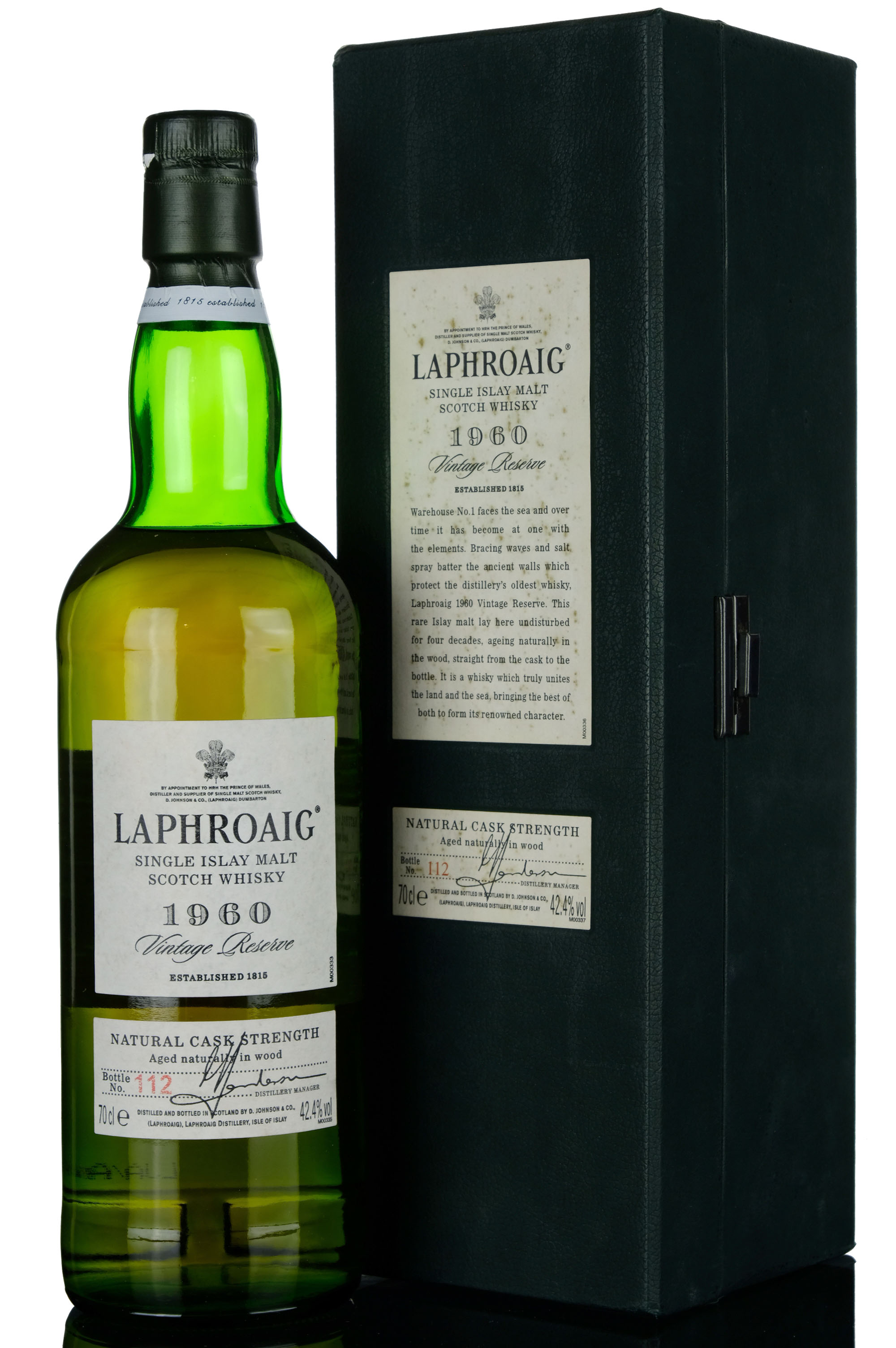


Laphroaig 1960-2001 - 40 Year Old - Oddbins Exclusive
Laphroaig 1960 - 2001. 40 Year Old. One of 300 bottles exclusively for Oddbins. 70cl. 42.4%.
An exceptionally rare 1960 vintage Laphroaig, bottled in 2000 after 40 years of ageing. This remarkable Islay single malt was released as part of a limited edition of just 300 individually numbered bottles, produced exclusively for the British wine merchant Oddbins ahead of the main release of Laphroaig's celebrated 40 Year Old. Bottled at natural cask strength of 42.4%.
What makes this release especially interesting is its declared 1960 vintage, a detail absent from the subsequent general release. The 1960 Laphroaig 40 Year Old holds an important place in the distillery's history, representing both the earliest vintage and the oldest age statement to appear on an official Laphroaig bottling at the time.
Distilled during an extraordinary period in Laphroaig's history, this whisky dates from the era when Bessie Williamson was managing the distillery, having inherited it following the death of Ian Hunter in 1954. Laphroaig was still producing whisky using its traditional floor maltings, with much of its character shaped by heavily peated malt, direct-fired stills and maturation in American oak casks. Whisky from this period has acquired an almost legendary reputation among enthusiasts, particularly for its combination of distinctive medicinal peat smoke, tropical fruit and remarkable depth.
An outstanding piece of Laphroaig history, combining a remarkable 1960 vintage, four decades of ageing and the additional rarity of the original 300-bottle Oddbins exclusive release. A particularly desirable bottling for collectors of historic Islay single malts.

An iconic southern Islay distillery, Laphroaig is the benchmark for heavily-peated smoky single malt whisky. The distillery has been Islay’s most successful single malt for many decades now, so much so that in 1908, following a commercial dispute, White Horse’s Peter Mackie famously tried to create a copy of Laphroaig at Lagavulin, leading to the birth of Malt Mill.
Today, the most revered and sought-after Laphroaigs at auction fall broadly into two camps: the old official bottlings of Laphroaig 10-year-old from the late 1960s-1980s; and the extraordinary independent bottlings of 1960s and early 1970s vintages by Gordon & MacPhail, Signatory, Cadenhead’s and the Italian bottlers Samaroli and Intertrade. The common denominator in these legendary bottlings is a remarkably fruity character alongside the phenolic bombast - sadly this fruitiness is no longer found in Laphroaig’s modern distillate.
Distillery bottlings are, as the name suggests, bottled by or for the distillery from which the whisky has originated and are thus often referred to as Official Bottlings or OBs. Distillery bottlings are generally more desirable for collectors and usually fetch higher prices at auction than independent bottlings. They are officially-endorsed versions of the whisky from a particular distillery and are therefore considered the truest expression of the distillery’s character.
This ideal of the distillery character is regarded so seriously by the distilleries and brand owners that casks of whisky that are considered to vary too far from the archetype are frequently sold on to whisky brokers and independent bottlers. When this happens, it is often with the proviso that the distillery’s name is not allowed to be used when the cask is bottled for fear of diminishing or damaging the distillery’s character and status.